Hardwood Floor Refinishing
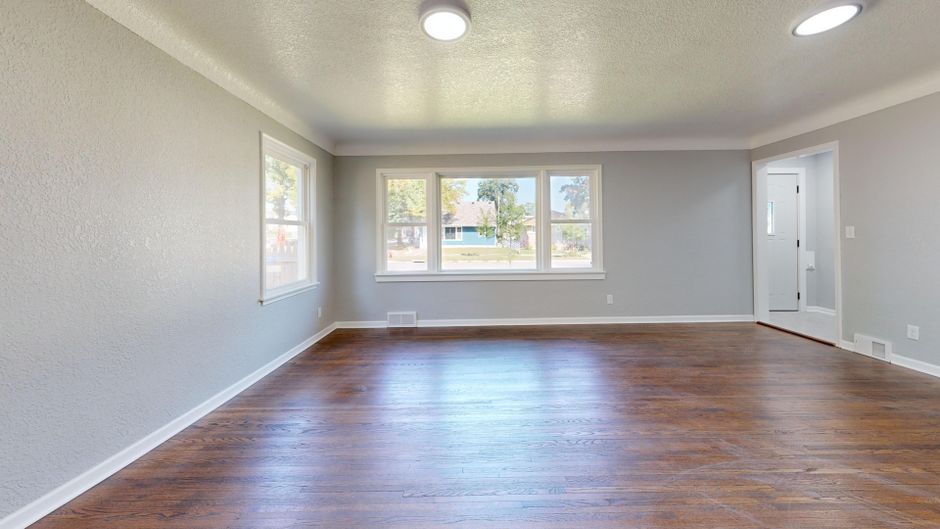
Hardwood floor refinishing renews a wood floor whose finish has dulled, scratched or worn through. The National Wood Flooring Association (NWFA), the wood flooring industry's trade association, recommends a complete sand and refinish when a floor has damage such as deep scratches and dents, and when the finish has worn away and bare wood shows (NWFA, Refinishing Your Floors, as of 2026).
This page explains what the work involves from the first sanding cut to the last coat, how it differs from a recoat and from repair, and where color, stairs and price come in. It is written for homeowners in Cedar Rapids, Marion, Iowa City and the nearby towns who want to know what to ask for in a quote. The cost figures on this page are national ranges from consumer cost guides. They are not Cedar Rapids prices, and they are not what any contractor charges.
What refinishing involves
Sources describe refinishing as sanding a floor back to bare wood and then applying a new finish. Bona, a floor-care manufacturer, describes its refinish treatment the same way: the floor is sanded to bare wood, a sealer or stain goes on, and then the finish (Bona, Revive, Recoat and Refinish my Floors, as of 2026). The steps below follow those sources. Product instructions differ from one another, so the details are examples, not a rule for every floor.
- Sanding in cuts. A wood-floor extension publication from Purdue and the U.S. Forest Service's Forest Products Laboratory, Finishing and Maintaining Wood Floors (1980), describes sanding in successive cuts from coarse to fine grit: two cuts, or three if the floor is uneven. It also advises removing no more wood than absolutely necessary (USDA Forest Products Laboratory, 1980). The floor sanding page covers the grit ranges that manufacturers give.
- Stain or sealer, if used. NWFA says sanding a floor back to raw wood is the opportunity to change its color, and stains are how natural wood color is toned or changed (NWFA, as of 2026). Some finish systems also call for a sealer before the finish. See staining and color change.
- Finish coats. The number of coats is set by the product. The table below shows what three manufacturer data sheets call for.
- Drying and curing. Each coat must dry before the next goes on, and the finish then cures. Drying and cure times belong to each product, so how long refinishing takes sets three data sheets side by side. Bona's website says its own refinish treatment leaves a floor ready in 2-4 days (Bona, as of 2026). That is Bona's claim for its own system, not a figure for every job.
- Returning the floor to use. All three data sheets in the table allow light foot traffic 24 hours after the last coat. Two also hold back rugs: Bona until the finish has fully cured, and Minwax's water-based product for seven days (data sheets dated 05/27/2026, 1/30/2026 and, for the water-based product, undated and read in 2026). The same article, how long refinishing takes, covers furniture and rugs.
Finish coats in three manufacturer data sheets
| Product | Coats the data sheet names | Data sheet |
|---|---|---|
| Bona Traffic HD (two-component waterborne finish) | A sealer or stain, then 2 coats; a third coat recommended in heavy-traffic areas | Bona, dated 05/27/2026 |
| Minwax Super Fast-Drying Polyurethane for Floors 350 V.O.C. (oil-based) | A second coat, and a third if the floor was not stained or sealed | Minwax, Rev. 1, 1/30/2026 |
| Minwax Ultra Fast-Drying Polyurethane for Floors (water-based, 275 V.O.C.) | 2 coats over stain or for a screen and recoat; 3 coats on bare wood | Minwax, undated, read in 2026 |
These are three example products, not a description of every finish. The sheets themselves are here: Bona Traffic HD, Minwax oil-based and Minwax water-based.
Refinishing, recoating and repair: how the terms differ
NWFA and Bona do not share one vocabulary, so it helps to see how each describes the work.
- NWFA: a maintenance coat cleans the existing finish, lightly sands it and applies a fresh coat. When a new coat does not meet the needs of the floor, a resand may be in order. A complete sand and refinish is for damage and for a finish that has worn away (NWFA, as of 2026).
- Bona: polishing adds a new layer over the existing finish; recoating lightly scuffs the finish with a buffer and adds a new coat; refinishing completely removes the existing finish. Bona says refinishing can repair moderate to severe damage or change the color of a floor, and that it takes the most labor. It calls recoating excellent preventative maintenance (Bona, as of 2026).
- Repair: NWFA says minor scratches can be touched up with touch-up markers, stain pens and repair kits, and that a professional can help with bigger repairs (NWFA, as of 2026).
On this site the terms are used in this way. Refinishing means sanding to bare wood and applying a new finish, and it is the subject of this page. Screen and recoat is the lighter maintenance coat; see screen and recoat, and screen and recoat vs full refinish explains how to choose between the two. Restoration and repair deals with damage and can come before either one; see restoration and repair. A quote that uses the words "resurfacing" or "restoring" should say which of these it means.
Sanding is where the wood comes off
Sanding removes the old finish and evens the surface, and it is the step that takes wood off the floor. The 1980 USDA publication says most flooring is 3/4 inch thick, so it can withstand a number of sandings, and that a floor thinner than 3/4 inch or made of hardwood plywood needs care to prevent sanding through. It adds that the thickness can usually be found by removing a heating register, or the shoe mold and baseboard, so that an edge of the floor shows (USDA Forest Products Laboratory, 1980).
NWFA says how many times a floor can be sanded depends on the contractor's skill, the equipment used, the thickness of the wear layer, the flatness of the floor and its condition. NWFA's own consumer pages give no number, and this site does not use the different figure NWFA's trade magazine has separately published (see refinish or replace), for the same reason it does not use Bona's marketing figure. NWFA also says solid wood flooring can be sanded and refinished many times, and that engineered wood flooring can be refinished but not as many times as solid wood (NWFA, as of 2026). Refinish or replace covers how to judge a floor.
Choosing color and finish
Sanding to raw wood is when a floor's color can change. NWFA describes water-based finishes as normally clear and very durable, with short drying times, and oil-based finishes as amber in color and very durable (NWFA, Finishes, as of 2026). NWFA also describes sheen levels, from gloss, which has the most shine, through semi-gloss and satin to matte, which has the least, and notes that less sheen makes small scratches and normal wear less noticeable. The article on water-based vs oil-based finish compares them, and staining and color change covers color.
Working on part of a floor
The 1980 USDA publication says that when surface finishes must be renewed, it is usually necessary to refinish the entire room. Minwax's data sheet for its oil-based floor finish tells the user to apply thin coats and keep a wet edge to avoid lap marks (Minwax data sheet, Rev. 1, 1/30/2026). A quote for less than a full room should say where the new finish will stop and how that edge will be handled.
Stairs
Stairs are covered on this page rather than on a page of their own. The cost guides read for this site publish per-step figures, and they differ. HomeGuide (as of 2026) lists $25-$85 per step. Thumbtack (last updated July 8, 2026) lists $80-$140 per step. The top of HomeGuide's range is barely above the bottom of Thumbtack's. These are national ranges from consumer cost guides, not Cedar Rapids prices and not what any contractor charges.
Whether a staircase was ever carpeted, what its treads are made of and what condition they are in are questions for the person preparing a quote. No source read for this site describes stair-specific work, so this page does not describe any. What refinishing costs sets the cost guides side by side.
Why floors need refinishing
Bona says a floor's finish is slowly worn down by daily wear (Bona, as of 2026). The 1980 USDA publication says finishes are best renewed when they begin to show wear in traffic channels but before bare wood is exposed. NWFA's advice for a complete sand and refinish starts at the point where the finish has worn away and bare wood shows (NWFA, as of 2026).
Bona's homeowner guide lists signs that a floor is ready for refinishing: dulling that continues despite routine care, major scratches or gouges, sun fading, stains that will not come out, water damage, or a wish for a new look. It says water damage should be assessed as minor or major, and that some floorboards may need replacing (Bona, as of 2026).
Wax and polish get in the way of a new finish. The 1980 USDA publication says wax may interfere with the drying and adhesion of any new finish, and Bona's data sheet warns that adhesion failure can occur when a floor being recoated is not free of wax, polish and oily residues (Bona data sheet, 05/27/2026). The article on screen and recoat vs full refinish explains why that matters when choosing between a recoat and a full refinish.
What affects the price
Angi and HomeGuide (both 2026) each give separate figures for staining, finish coats, repairs and carpet removal; HomeGuide also gives figures for stairs and furniture moving. The guides' figures for these differ from one another, so what refinishing costs lays out each range with its date and says plainly where the guides disagree.
Asking for a quote
To ask for a quote, request a quote or call 914-530-6133. The towns covered are listed under service areas. Useful details to have ready are the rooms involved and their approximate size, whether the floor is to be stained or changed in color, whether there are stairs, any visible damage, and any carpet to be removed or furniture to be moved. A written quote that says which of these are included and which are extra is easier to compare with another.